
Running Electric Kettles Off-Grid 2025-2026: Inverters, Generators & Solar Power Guide
Complete guide to using electric kettles off-grid. Learn inverter sizing, generator requirements, solar panel calculations, and best low-wattage kettles for van life, RVs, and camping.
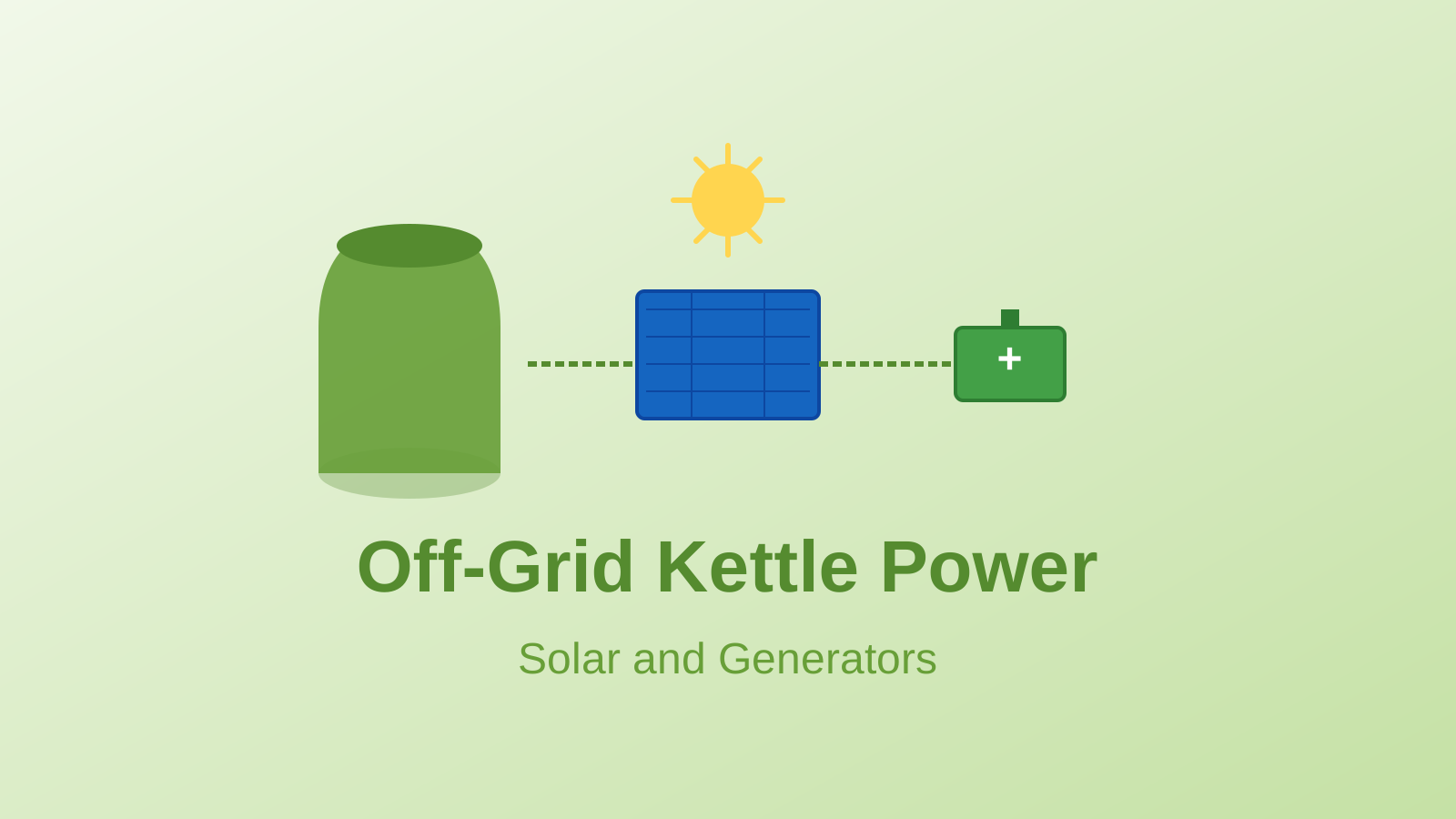
Table of Contents
- Understanding Electric Kettle Power Requirements
- Running Kettles on Inverters
- Running Kettles on Generators
- Running Kettles on Solar Power
- Best Kettles for Off-Grid Use
- Real-World Off-Grid Scenarios
- Energy Conservation Strategies
- Safety Considerations Off-Grid
- Cost-Benefit Analysis: Kettle vs Alternatives
- Conclusion
Running electric kettles off-grid in 2025-2026 is entirely feasible with proper equipment sizing and understanding of power requirements. Standard 1500W kettles demand substantial power from inverters, batteries, or generators, but specialized low-wattage models (500-1000W) work reliably on modest off-grid systems. The key is matching kettle wattage to your power source capacity while accounting for surge current on startup.
Understanding Electric Kettle Power Requirements
Critical Distinction
Electric kettles have two power ratings you must understand: continuous wattage (the normal operating power) and surge wattage (the brief spike when first turned on). Your power system must handle both.
Continuous vs Surge Power
Continuous Power: The steady wattage draw while heating. This is the number advertised on the kettle (e.g., “1500W”).
Surge Power: The momentary spike when the heating element first engages, typically 1.5-2× continuous power. A 1500W kettle might surge to 2250-3000W for 1-3 seconds.
Why Surge Matters: Inverters and generators must handle surge power or they’ll shut down on overload protection. A 2000W inverter might run a 1500W kettle fine once started, but if surge protection triggers at 2000W peak, the kettle never starts.
Sizing Rule of Thumb: Your power system should provide 1.5-2× the kettle’s continuous wattage to handle surges comfortably.
Wattage Categories and Boiling Times
| Wattage | Typical Use | 1L Boil Time | Power System Required |
|---|---|---|---|
| 500-750W | Low-power travel kettles | 8-10 min | 1000W+ inverter/system |
| 800-1000W | Compact RV kettles | 6-8 min | 1500W+ inverter/system |
| 1200-1500W | Standard household kettles | 3.5-5 min | 2500W+ inverter/system |
| 1800-2200W | Rapid boil kettles | 2.5-3.5 min | 3500W+ inverter/system |
Off-Grid Reality: Most van life, RV, and solar setups target 500-1000W kettles as the practical sweet spot between boil time and power demand.
Running Kettles on Inverters
Pure Sine Wave vs Modified Sine Wave
Pure Sine Wave Inverters (Required for Kettles):
- Produce smooth AC power identical to grid electricity
- All kettles work perfectly
- Slightly more expensive ($200-500 for 2000W)
- Essential for temperature-controlled kettles with electronics
Modified Sine Wave Inverters (Not Recommended):
- Produce choppy “stepped” AC approximation
- Can damage electronic controls
- May cause buzzing or inefficient heating
- Cheaper but unsuitable for most modern kettles
Verdict: Only use pure sine wave inverters for electric kettles in 2025-2026. The risk of damage and inefficiency isn’t worth the $50-100 savings.
Inverter Sizing for Different Kettle Wattages
For 500W Kettle:
- Minimum: 800W continuous, 1000W surge inverter
- Recommended: 1000W continuous, 1500W surge
- Battery draw: ~40-45 amps at 12V for 8-10 minutes
- Typical models: Small travel kettles, mini 0.5L kettles
For 1000W Kettle:
- Minimum: 1500W continuous, 2000W surge inverter
- Recommended: 2000W continuous, 3000W surge
- Battery draw: ~85-90 amps at 12V for 6-7 minutes
- Typical models: Compact 1L kettles, travel kettles
For 1500W Kettle:
- Minimum: 2500W continuous, 3500W surge inverter
- Recommended: 3000W continuous, 4500W surge
- Battery draw: ~130-140 amps at 12V for 4-5 minutes
- Typical models: Standard household 1.5-1.7L kettles
For 12V Systems: Divide wattage by 10 for approximate amp draw (e.g., 1000W ≈ 100A) For 24V Systems: Divide wattage by 20 for approximate amp draw (e.g., 1000W ≈ 50A)
Critical: These are sustained amp draws. Your battery bank must deliver this current without voltage sag, or the inverter will shut down.
Battery Capacity Requirements
Energy Consumption Per Boil:
- 500W kettle (10 min): ~85 Wh
- 1000W kettle (7 min): ~117 Wh
- 1500W kettle (5 min): ~125 Wh
Battery Bank Sizing: Convert watt-hours to amp-hours at your system voltage:
- 12V system: Divide Wh by 12 (e.g., 125 Wh ÷ 12 = 10.4 Ah per boil)
- 24V system: Divide Wh by 24 (e.g., 125 Wh ÷ 24 = 5.2 Ah per boil)
Daily Usage Calculation: For 3 boils per day with 1000W kettle:
- 3 boils × 117 Wh = 351 Wh daily
- At 12V: 351 ÷ 12 = 29.25 Ah daily
- With 50% depth of discharge limit: Need 60 Ah usable capacity
- With lithium (80% usable): 75 Ah total battery
- With AGM/lead-acid (50% usable): 120 Ah total battery
Minimum Battery Banks:
- Light use (1-2 boils daily, 500-750W kettle): 100Ah 12V lithium or 200Ah AGM
- Moderate use (2-3 boils, 1000W kettle): 200Ah 12V lithium or 400Ah AGM
- Heavy use (4+ boils, 1500W kettle): 400Ah+ 12V lithium or 800Ah+ AGM
Remember: Batteries should never be your only load. Factor in other power needs (lights, fans, electronics) when sizing.
Cable Sizing for High Current
High-current draws require properly sized cables to prevent voltage drop and fire hazards:
12V System Wire Sizing:
- 75A draw (1000W): 2 AWG cable (33mm²) for runs under 3ft, 1 AWG for longer
- 125A draw (1500W): 1/0 AWG cable (53mm²) for runs under 3ft, 2/0 for longer
- Use quality crimped terminals: No twist connectors or weak connections
Wire Too Small = Voltage Drop = Inverter Shutdown
Most inverter shutdowns aren’t actually inverter problems—they’re voltage drop from undersized cables causing the inverter to see battery voltage below cutoff threshold.
Running Kettles on Generators
Generator Sizing
For 500-750W Kettles:
- Minimum: 1000W generator
- Comfortable: 1500W generator
- Example: Honda EU1000i, Yamaha EF1000iS
For 1000-1200W Kettles:
- Minimum: 1800W generator
- Comfortable: 2000W generator
- Example: Honda EU2200i, Champion 2000W inverter generator
For 1500W Kettles:
- Minimum: 2500W generator
- Comfortable: 3000W generator
- Example: Honda EU3000iS, Champion 3100W inverter generator
Generator Type: Inverter generators are vastly superior for off-grid living:
- Quiet operation (essential for camping)
- Fuel efficient at low loads
- Clean power safe for electronics
- Parallel capability (two small units = one large)
Fuel Consumption:
- 2000W inverter generator: ~0.1-0.15 gal/hour under load
- Boiling water 3× daily: ~15-20 minutes runtime = 0.05 gal/day
- Monthly fuel cost: ~$5-8 at $3.50/gallon (based on 2025-2026 pricing)
Generators work excellently for kettle use because the high power draw is brief. Running a generator for 5 minutes to boil water is efficient; running it all day for lights would be wasteful.
Running Kettles on Solar Power
Solar Panel Sizing
Direct Solar to Kettle (Not Recommended): Theoretically possible but impractical. A 1000W kettle needs 4-5× 300W panels producing full power simultaneously. Clouds or angle changes disrupt operation mid-boil.
Solar with Battery Buffer (Recommended Approach): Solar charges battery bank, which then powers kettle through inverter. This is the standard off-grid configuration.
Minimum Solar for Kettle Use:
Light Use (1-2 boils daily, 500W kettle):
- 200W solar minimum
- Replenishes 170 Wh daily (2 boils)
- Works with 100-150Ah lithium battery bank
Moderate Use (2-3 boils daily, 1000W kettle):
- 400W solar minimum
- Replenishes 350 Wh daily (3 boils)
- Works with 200-300Ah lithium battery bank
Heavy Use (4+ boils, 1500W kettle):
- 600-800W solar minimum
- Replenishes 500+ Wh daily
- Requires 400Ah+ lithium battery bank
Solar Assumption: 4-5 sun-hours per day average (varies by location and season). Florida gets 5-6 hours; Seattle gets 2-3 in winter.
Complete Solar Kettle System Example
Moderate Van Life System:
- Solar: 400W (2× 200W panels)
- Battery: 200Ah 12V LiFePO4 (~$500-800)
- Inverter: 2000W pure sine wave (~$300-500)
- Charge Controller: 30A MPPT (~$150-200)
- Kettle: 1000W compact model (~$30-50)
- Total Cost: ~$1000-1600
Capability:
- 3 kettle boils per day
- Plus lights, phone charging, laptop use, fan
- Self-sufficient in sunny weather
- Needs generator backup for extended cloudy periods
This represents the practical minimum for comfortable off-grid kettle use in a van or small RV.
Best Kettles for Off-Grid Use
Low-Wattage Travel Kettles (500-800W)
Advantages:
- Work with smaller inverters (1000-1500W)
- Lower battery draw
- More forgiving on modest systems
- Lightweight and compact
Disadvantages:
- Slow boiling (8-10 minutes for 1L)
- Usually smaller capacity (0.5-0.8L)
- Often plastic construction
- Basic features only
Best For: Ultra-light van life, motorcycle camping, minimal power systems
Examples: Folding travel kettles, compact 0.5L models
12V DC Kettles (Direct Battery Power)
How They Work: Plug directly into 12V cigarette lighter socket, bypassing inverter entirely.
Advantages:
- No inverter needed
- No conversion losses (more efficient)
- Work in vehicles while driving
- Simpler electrical setup
Disadvantages:
- Very slow (15-20 minutes to boil)
- Usually 120-180W maximum (circuit breaker limits)
- Heavy current draw through small plug (potential for overheating)
- Limited capacity and quality
Verdict for 2025-2026: 12V kettles are painfully slow and only practical for vehicles with no house battery system. If you have any inverter capacity, AC kettles are vastly superior.
Check our guide on kettles with cigarette lighter plugs for options.
1000W Compact Kettles (Sweet Spot)
Advantages:
- Reasonable boil time (6-7 minutes)
- Manageable 1500-2000W inverter requirement
- Available in stainless steel
- Some models offer temperature control
- 1-1.2L capacity sufficient for 2-3 people
Disadvantages:
- Still substantial power draw
- Need decent battery bank (200Ah+ lithium)
- Not as compact as 500W models
Best For: Well-equipped vans, RVs with solar, serious off-grid setups
Our Recommendation: This is the practical sweet spot for most off-gridders who have modest but real electrical systems.
Real-World Off-Grid Scenarios
Power Setup: Small portable power station (500Wh), no solar
Best Kettle: 500W travel kettle (0.5L capacity)
Usage: 2 boils per day = 170 Wh = 34% of battery capacity
Reality: Works perfectly for weekend trips. The power station can handle 4-5 boils before needing recharge from vehicle alternator or shore power.
Cost: Power station $300-500, kettle $20-40 = $320-540 total
Power Setup: 400W solar, 200Ah lithium, 2000W inverter
Best Kettle: 1000W compact kettle (1L capacity)
Usage: 3 boils per day = 350 Wh = 14% of battery capacity, replenished by solar
Reality: Comfortable daily use year-round in sunny climates. May need generator backup during multi-day cloudy weather.
Cost: Full electrical system ~$1500-2000 including kettle
Alternative: Some van-lifers keep a 500W backup kettle for cloudy days when conserving power, using the 1000W model on sunny days when power is abundant.
Power Setup: 1200W solar, 600Ah lead-acid battery bank, 3000W inverter
Best Kettle: Standard 1500W household kettle (1.7L)
Usage: 5-6 boils per day = 750 Wh = ~12% of usable battery capacity (assuming 50% depth of discharge = 3600 Wh usable)
Reality: Operates like a normal house. System has capacity for kettle plus refrigerator, lights, water pump, laptop use.
Cost: Full system $4000-6000 installed
Consideration: Generator backup (2000-3000W) for winter when solar production drops 60-70%.
Power Setup: 3000W generator, no solar/batteries
Best Kettle: Any standard 1500W kettle
Usage: Run generator for 5-10 minutes to boil water (and charge phones/laptops simultaneously to maximize generator efficiency)
Reality: Simple and reliable. Generator fuel cost is ~$0.10-0.15 per boil.
Efficiency Tip: Batch tasks during generator runtime. Boil water, charge devices, run microwave, etc., all during the same 15-20 minute session rather than starting/stopping generator multiple times daily.
Energy Conservation Strategies
Boil Only What You Need
In off-grid scenarios, energy consciousness matters. Choosing proper capacity prevents waste:
- Solo users: 0.5L kettle saves 50-60% energy vs boiling full 1.7L
- Couples: 1L capacity is sufficient
- Groups/families: 1.5-1.7L justified
Every 100ml of unnecessary water is ~8-10 Wh wasted—adds up to 50-100 Wh daily if you’re habitually overfilling.
Use Warm Starting Water
If you have a water heater or it’s summer with warm water tank, starting with 90°F water instead of 50°F saves ~15-20% of heating energy:
- Cold water (50°F to 212°F): 162°F rise = 100% energy
- Warm water (90°F to 212°F): 122°F rise = ~75% energy
Caution: Only use warm water from safe sources (modern water heaters, potable water). Never use hot tap water in old buildings with potential lead pipes.
Thermos Storage
Boil once in the morning, store in a quality vacuum thermos. Water stays hot (180-190°F) for 4-6 hours:
- Morning boil for coffee
- Mid-morning tea from thermos (no reboil needed)
- Afternoon tea from thermos
- Evening boil for dinner
This strategy reduces from 4 boils to 2 boils daily, cutting kettle energy use in half. A good thermos costs $25-40 and pays for itself in energy savings within months for off-gridders.
Batch Boiling
When using generators, maximize efficiency by boiling full capacity when generator is running for other tasks, then storing hot water in a thermos rather than multiple small boils throughout the day requiring separate generator sessions.
Safety Considerations Off-Grid
Inverter Placement and Ventilation
High-power inverters generate heat and need:
- Ventilation with 3-4 inches clearance on all sides
- Mounting on non-flammable surface
- Protection from moisture/water splash
- Fuses/circuit breakers properly sized for maximum draw
Kettle Use While Driving
Safe: Using 12V cigarette lighter kettles while driving Unsafe: Using AC inverter kettles while driving unless:
- Inverter is permanently installed with proper wiring
- Kettle is secured and can’t tip/spill
- Driver isn’t distracted by operation
Best Practice: Pull over before boiling water. Five minutes stopped is safer than risk of hot water spills or electrical issues while driving.
Fire Prevention
- Never leave kettle unattended while boiling
- Ensure auto shut-off works (test periodically)
- Don’t run kettle on inverter at same time as other high-draw appliances
- Keep CO detector if running generator inside vehicle (never recommended but some do)
Cost-Benefit Analysis: Kettle vs Alternatives
Electric Kettle Off-Grid:
- Setup cost: $500-2000 depending on existing electrical system
- Energy cost: ~15-25 Wh per cup (from batteries/solar)
- Time: 2-7 minutes depending on wattage
- Convenience: High (push button, automatic shut-off)
Propane Stove/Kettle:
- Setup cost: $100-300 for stove + stovetop kettle
- Fuel cost: ~$0.05 per boil (propane at $3/gallon)
- Time: 5-8 minutes
- Convenience: Moderate (need to watch, manual shutoff)
- Advantage: Works in any weather, no electrical dependency
Jetboil/Camp Stove:
- Setup cost: $100-150
- Fuel cost: ~$0.30 per boil (camp fuel canisters)
- Time: 2-4 minutes (very fast)
- Convenience: Moderate
- Advantage: Ultralight for backpacking
Verdict: If you already have adequate off-grid electrical (for other devices), adding kettle use is marginal additional cost and maximum convenience. If building system solely for kettle, propane is more cost-effective.
However, most van-lifers and off-gridders want electrical systems anyway (lights, devices, fans, refrigeration), so kettle becomes a reasonable addition rather than the sole justification for the investment.
Conclusion
Running electric kettles off-grid in 2025-2026 is practical with proper system sizing and appropriate kettle selection. The key decisions are:
- Choose low-wattage kettles (500-1000W) rather than standard 1500W models unless you have substantial power systems
- Size inverters to 1.5-2× kettle wattage to handle surge current comfortably
- Budget battery capacity for multiple boils plus other daily electrical needs
- Match system to usage: Weekend camping needs 500Wh portable power station; full-time van life needs 200Ah+ lithium with 400W+ solar
For most off-gridders, a 1000W compact kettle powered by a 2000W inverter, 200-300Ah lithium battery, and 400W solar represents the sweet spot of capability, cost, and convenience. This setup boils water in 6-7 minutes while maintaining enough power for other daily needs.
Alternative approaches like propane kettles or 12V DC kettles work but sacrifice either convenience (propane) or time (12V). The electric kettle’s push-button simplicity and automatic shut-off make it worth the electrical investment for many off-gridders once their system reaches minimal capability thresholds.
For related information on selecting appropriate kettles, see our guides on small portable kettles, travel kettles, 12V cigarette lighter models, energy efficiency, and capacity selection.
Related Posts
Are Electric Kettles Recyclable? A Comprehensive Guide
Discover how to responsibly recycle your electric kettle and other household appliances. Learn about the WEEE Directive, recycling processes, and the environmental impact of proper disposal.
Understanding Kettle Safety Ratings: The Importance of the Electric Kettle Minimum Mark
Learn about electric kettle safety ratings, the significance of the minimum water mark, and how to ensure safe and efficient use of your kettle. Discover tips for extending your kettle's lifespan and saving energy.
How Long Do Electric Kettles Last? Complete Lifespan & Maintenance Guide 2025-2026
Discover how long electric kettles last by material type, signs your kettle needs replacement, and proven maintenance strategies to extend kettle lifespan up to 10+ years.