
How to Choose the Right Electric Kettle Capacity 2025-2026: Complete Sizing Guide
Choose the perfect electric kettle capacity for your household. Comprehensive guide covering 0.5L to 2L+ options, household size matching, and when bigger isn't better.
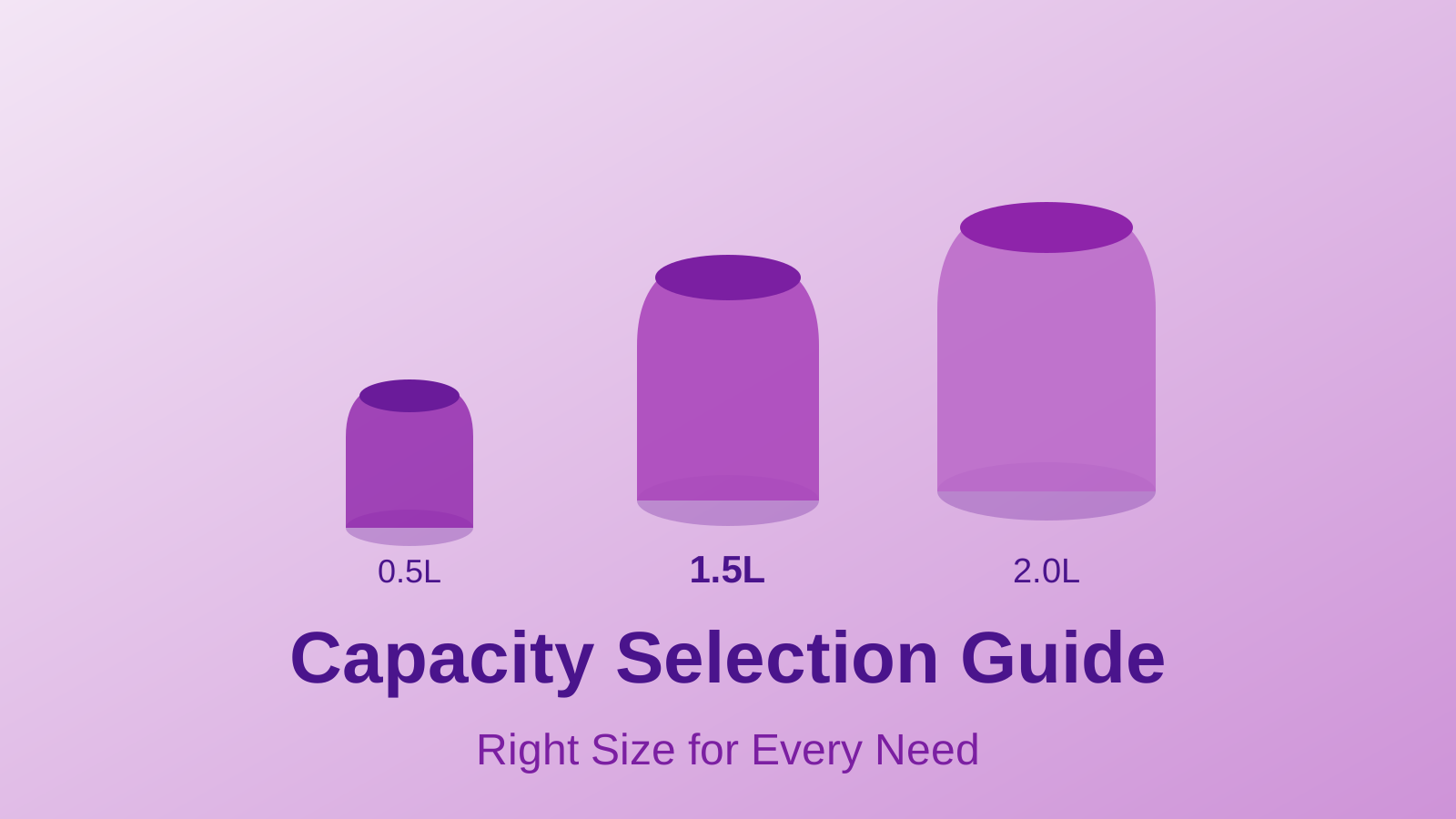
Table of Contents
- Quick Capacity Reference Guide
- Detailed Capacity Guide by Household Size
- When Bigger Isn’t Better: Common Mistakes
- Space and Storage Considerations
- Capacity and Specialty Uses
- How Capacity Affects Boiling Time
- Matching Capacity to Beverage Types
- Capacity and Energy Efficiency
- Special Features by Capacity Size
- Recommendations by Lifestyle
- Conclusion
Choosing the right electric kettle capacity is crucial for efficiency, cost-effectiveness, and daily convenience. In 2025-2026, kettles range from 0.5L personal sizes to 2.5L+ family models. The ideal capacity depends on household size, beverage habits, counter space, and energy consciousness. Most people overestimate their needs—the right size boils faster, wastes less energy, and often costs less.
Quick Capacity Reference Guide
- 0.5L (17 oz): Perfect for 1 person, travel, or single servings
- 0.8-1.0L (27-34 oz): Ideal for 1-2 people or couples
- 1.2-1.5L (40-50 oz): Best for 2-3 people or small families
- 1.7-1.8L (57-61 oz): Standard size for 3-4 people or moderate office use
- 2.0L+ (68+ oz): Large families (5+), offices, or frequent entertaining
Important Rule
Choose capacity based on your typical daily use, not maximum possible use. A kettle that’s too large wastes energy heating unnecessary water and takes up valuable counter space.
Detailed Capacity Guide by Household Size
0.5L Kettles: Personal and Travel Use
Best For: Single person households, travel, dorm rooms, office desks, RVs
Capacity Details:
- Boils enough for 1-2 cups of tea or coffee (8-16 oz)
- Heats in 2-3 minutes with typical 1000-1200W power
- Extremely compact footprint (often 6-7 inches tall)
- Minimum fill line usually 200ml, perfect for single servings
Advantages:
- Fastest boiling time: Small volume heats quickly even with lower wattage
- Maximum energy efficiency: Never waste energy on excess water
- Ultra-portable: Ideal for travel, dorm rooms, or small apartments
- Lowest cost: Budget-friendly options start around $15-20
Limitations:
- Requires refilling for entertaining or multiple consecutive cups
- Not suitable for families or offices with multiple users
- Limited to basic features (rarely includes temperature control)
Real-World Use Case: Sarah lives alone and drinks 2-3 cups of green tea daily. Her 0.5L kettle heats exactly what she needs in under 3 minutes, using minimal counter space in her studio apartment. She’s never wished it was larger. Check our guide on best small electric kettles for specific recommendations.
0.8-1.0L Kettles: Couples and Light Use
Best For: Couples, light tea/coffee drinkers, minimalist kitchens
Capacity Details:
- Holds 3-4 cups worth of water
- Boils in 3-4 minutes with 1200-1500W
- Compact but more substantial than 0.5L models
- Good balance between size and capacity
Advantages:
- Versatile sizing: Handles both solo and couple usage
- Still energy-efficient: Small enough to avoid wasting energy
- Better features: Often includes temperature control and nicer materials
- Reasonable footprint: Fits most kitchens comfortably
Limitations:
- May require refilling when entertaining 3+ guests
- Not ideal for families with children
- Limited for households with heavy hot beverage consumption
Real-World Use Case: Mike and Jennifer share morning coffee and occasional afternoon tea. Their 1.0L kettle boils enough for two French press servings or 3-4 cups of tea without excess. When guests visit, they simply boil twice—a minor inconvenience that doesn’t justify a larger kettle taking up permanent space.
1.2-1.5L Kettles: Small Families and Moderate Use
Best For: 2-3 person households, moderate beverage consumption, small offices (5-8 people)
Capacity Details:
- Holds 5-6 cups of water
- Boils in 4-5 minutes with standard 1500W heating
- Mid-size profile fits most kitchen aesthetics
- Sweet spot for many households
Advantages:
- Family-appropriate: Serves 2-3 people simultaneously
- Entertaining-friendly: Enough for small gatherings without multiple boils
- Efficient: Not so large that you’re constantly heating excess water
- Full features: Usually includes all premium features like variable temperature
Limitations:
- May be too small for larger families or offices
- Takes slightly longer to boil than smaller capacities
- Slightly higher energy use if you’re typically making single cups
Real-World Use Case: The Martinez family (two adults, one teenager) drinks tea and hot chocolate regularly. Their 1.5L kettle handles their breakfast routine where all three want hot beverages, plus it’s perfect for evening tea without being oversized. It’s their Goldilocks capacity—just right.
1.7-1.8L Kettles: Standard Family Size
Best For: 3-4 person families, moderate office use, frequent entertaining
Capacity Details:
- Holds 7-8 cups of water
- Boils in 5-6 minutes with 1500W (3-4 minutes with 2000W+)
- Standard kettle size in most markets
- Maximum capacity for most countertop models
Advantages:
- Most common size: Widest selection of models and styles
- Family-ready: Easily serves 3-4 people simultaneously
- Guest-friendly: No need to reboil when entertaining
- Competitive pricing: Economies of scale make these often best value
Limitations:
- Energy waste for solo users: Heating 1.7L for one cup wastes significant energy
- Slower boiling: Takes longest to reach temperature
- Larger footprint: Requires more counter space
- Heavier when full: 1.7L of water weighs about 3.7 lbs plus kettle weight
Real-World Use Case: The Johnsons (family of four) use their 1.7L kettle multiple times daily. Morning chaos with everyone wanting breakfast beverages is handled in one boil. However, when just Dad makes afternoon coffee, he’s learned to fill only halfway to save time and energy. Our article on large capacity kettles explores these models in detail.
2.0L+ Kettles: Large Families and Offices
Best For: Families of 5+, office environments (10+ people), frequent large gatherings
Capacity Details:
- Holds 8+ cups of water
- Boils in 6-8 minutes depending on wattage
- Substantial size requires dedicated counter space
- May exceed standard kettle base sizes (check dimensions)
Advantages:
- Maximum capacity: Handles large groups without reboiling
- Office-appropriate: Reduces waiting time in workplace settings
- Entertaining: Perfect for parties and gatherings
- Rare refilling: Reduces daily fill-up frequency
Limitations:
- Very slow solo use: Boiling full capacity takes significant time
- High energy waste: Solo users waste enormous energy
- Large footprint: Dominates counter space
- Heavy: Can be awkward to lift and pour when full
- Higher cost: Premium pricing for larger capacity
Real-World Use Case: An accounting firm with 15 employees installed a 2.2L kettle in their break room. It handles morning rush efficiently, with capacity for 8-10 cups in one boil. However, they recommend filling only what’s needed at slower times to avoid wasting energy and time. Check our office kettles guide for workplace-specific considerations.
When Bigger Isn’t Better: Common Mistakes
Avoid the Oversizing Trap
Many people buy the largest kettle “just in case” but end up wasting energy, time, and money heating water they don’t need every single day.
The Energy Waste Problem
Example Calculation:
- Single person uses 1.7L kettle daily for one 250ml cup of tea
- Energy to boil 250ml: ~0.022 kWh = $0.0035
- Energy to boil 1700ml: ~0.150 kWh = $0.024
- Daily waste: $0.021
- Annual waste: $7.60
- 10-year waste: $76
While $7.60/year doesn’t sound significant, you’re also waiting 6 minutes instead of 2 minutes, and heating your kitchen unnecessarily. Over a decade, that’s 260 hours (nearly 11 days) of your life spent waiting for excess water to boil.
The Counter Space Reality
Kitchen counter space is precious real estate. A 1.7L kettle occupies roughly 8-10 inches of counter space compared to 6-7 inches for a 0.8L model. In small kitchens or apartments, this difference is substantial.
Minimalist Approach: Buy the smallest kettle that handles your typical use, and simply refill on the rare occasions you need more. The convenience of extra capacity doesn’t offset the daily inconvenience of a larger footprint.
The “Just in Case” Fallacy
Many people justify large kettles thinking: “What if I have guests?”
Reality Check: If you entertain weekly and serve tea to 6+ people regularly, a large kettle makes sense. If you entertain 3-4 times per year, simply boil twice on those rare occasions. Don’t let infrequent scenarios dictate daily appliance choices.
Space and Storage Considerations
Counter Space Requirements
Compact (0.5-0.8L): 6-7 inches diameter, 7-8 inches tall
- Fits in tight spaces
- Easy to store in cabinet when not in use
- Ideal for minimalist or small kitchens
Standard (1.2-1.7L): 7-9 inches diameter, 9-11 inches tall
- Requires dedicated counter spot
- Too bulky for convenient cabinet storage
- Best with permanent countertop placement
Large (2.0L+): 8-10+ inches diameter, 10-12 inches tall
- Dominates counter space
- Awkward for cabinet storage
- Requires committed permanent location
Aesthetic Considerations
Kettle size significantly impacts kitchen aesthetics:
Visual Balance: A massive 2L kettle on a small apartment counter looks disproportionate and clutters the space. A sleek 0.8L model maintains visual harmony.
Design Integration: Smaller kettles integrate better with minimalist kitchen designs popular in 2025-2026. Large kettles become focal points whether you want them to or not.
Color and Material: If you’re choosing based on aesthetics, ensure the capacity still meets your functional needs. A beautiful kettle that’s the wrong size serves neither form nor function well.
Capacity and Specialty Uses
Travel Kettles
Travel kettles typically range from 0.5-0.8L, prioritizing portability over capacity. Features include:
- Dual voltage (120V/240V) for international use
- Collapsible designs for packing
- Lightweight materials
- Lower wattage (800-1000W) to work with hotel electrical systems
Selection Tip: For travel, choose the smallest capacity you can tolerate. Space and weight in luggage matter more than maximum capacity.
Dorm and Hostel Use
Dorm room kettles and hostel kettles benefit from compact sizes:
- 0.5-1.0L capacity suits individual needs
- Smaller footprint fits limited personal space
- Lower purchase price matches student budgets
- Easy to pack when moving
Selection Tip: Students sharing spaces might pool resources for a 1.2-1.5L kettle, but individuals should stick with 0.5-0.8L to match solo usage patterns.
RV and Van Life
Mobile living spaces require special capacity considerations:
- 0.5-0.8L ideal: Minimizes space and weight
- Lower wattage important: Many RV electrical systems limit wattage to 1000-1200W
- Secure storage: Smaller kettles store safely during travel
- Water conservation: Smaller capacities encourage using only needed water
Check if your RV’s electrical system can handle standard 1500W kettles or if you need lower-wattage models.
Office Environments
Office kettles require different capacity logic:
- Small offices (5-10 people): 1.5-1.7L handles morning rush
- Medium offices (10-20 people): 1.7-2.0L reduces waiting times
- Large offices (20+ people): Consider multiple 1.7L kettles in different areas rather than one giant kettle
Pro Tip: Multiple smaller kettles distributed across office areas work better than one large central kettle causing bottlenecks during peak times.
How Capacity Affects Boiling Time
Understanding the relationship between capacity and heating time helps set realistic expectations:
Approximate Boiling Times (from room temperature 68°F to 212°F):
| Capacity | 1000W | 1500W | 2000W+ |
|---|---|---|---|
| 0.5L | 4-5 min | 2-3 min | 1.5-2 min |
| 1.0L | 7-8 min | 3.5-4 min | 2.5-3 min |
| 1.5L | 10-11 min | 5-6 min | 3.5-4 min |
| 1.7L | 11-12 min | 6-7 min | 4-5 min |
| 2.0L | 13-14 min | 7-8 min | 5-6 min |
Key Insight: Doubling capacity approximately doubles boiling time with the same wattage. Higher wattage partially offsets this but can’t eliminate the time penalty of heating more water.
If speed matters to you (morning rush, impatient personality), smaller capacity is your friend. Our guide on fast-boil electric kettles explores the fastest options.
Matching Capacity to Beverage Types
Different beverages have different water requirements:
Coffee
- Single cup: 200-250ml (0.8-1.0 cups)
- French press (1-2 servings): 350-500ml (1.5-2 cups)
- French press (3-4 servings): 800-1000ml (3-4 cups)
- Pour-over: 250-400ml per serving
Tea
- Single cup: 200-250ml (0.8-1.0 cups)
- Teapot (2-3 servings): 500-750ml (2-3 cups)
- Large teapot (4-6 servings): 1000-1500ml (4-6 cups)
Other Beverages
- Hot chocolate: 250ml per serving
- Instant soup: 200-300ml per serving
- Baby formula: 150-250ml per bottle
- Oatmeal/instant meals: 200-300ml per serving
Calculation Tip: Identify your most common use case and add 20% for spillage and evaporation. This gives your ideal minimum capacity.
Capacity and Energy Efficiency
From an energy perspective, the most efficient kettle is the smallest one that meets your needs:
Energy Cost Comparison (based on $0.16/kWh electricity):
- 0.5L full boil: $0.01
- 1.0L full boil: $0.014
- 1.5L full boil: $0.020
- 1.7L full boil: $0.024
- 2.0L full boil: $0.028
Annual Energy Costs (4 boils daily):
- 0.5L: $14.60/year
- 1.0L: $20.44/year
- 1.5L: $29.20/year
- 1.7L: $35.04/year
- 2.0L: $40.88/year
The difference between smallest and largest is $26/year—not life-changing, but measurable. More importantly, the environmental impact scales proportionally. For a deep dive into costs, see our article on electric kettle energy costs.
Special Features by Capacity Size
Small Capacity (0.5-0.8L) Features
- Basic on/off operation (temperature control rare)
- Lightweight materials (often plastic)
- Compact bases
- Travel-friendly dual voltage
- Budget-friendly pricing
Medium Capacity (1.0-1.5L) Features
- Variable temperature control common
- Better material options (stainless steel, glass)
- Keep-warm functions
- Digital displays
- Mid-range pricing
Large Capacity (1.7L+) Features
- Full feature sets standard
- Premium materials and construction
- Temperature control
- Programmable functions
- Rapid boil high-wattage options
- Higher price points
Recommendations by Lifestyle
Recommended Capacity: 0.5-0.8L
Reasoning: You’ll rarely need more than 2-3 cups at once. Smaller capacity boils faster, uses less energy, takes less counter space, and costs less. Perfect for apartments, dorm rooms, or minimalist lifestyles.
Best Match: Small 0.5L kettles with basic features and compact design.
Recommended Capacity: 0.8-1.2L
Reasoning: Handles two people’s morning beverages comfortably while remaining efficient for solo afternoon use. Good balance between versatility and efficiency.
Best Match: Mid-size kettles with temperature control for different beverage preferences between partners.
Recommended Capacity: 1.5-1.7L
Reasoning: Family size demands capacity for simultaneous servings during mealtimes. Standard 1.7L size offers widest selection and best value. Teaches family members to fill appropriately rather than always boiling full capacity.
Best Match: Standard family kettles with durability focus and safety ratings for households with children.
Recommended Capacity: 1.7-2.0L
Reasoning: Large households benefit from maximum capacity to handle peak demand times. Consider high-wattage models to offset longer boiling times. Alternatively, two medium kettles in different locations may work better than one giant kettle.
Best Match: Large capacity kettles with rapid boil technology and commercial-grade durability.
Recommended Capacity: 1.5L + secondary 0.8L
Reasoning: Rather than oversizing your daily kettle for occasional parties, keep a medium kettle for daily use and a smaller secondary kettle for entertaining. Two kettles working simultaneously boil faster than one giant kettle and provide flexibility.
Best Match: Attractive kettle for daily visible use, practical secondary for peak demand.
Recommended Capacity: Depends on employee count
- 5-10 employees: 1.5L
- 10-20 employees: 1.7-2.0L
- 20+ employees: Multiple 1.7L in different areas
Reasoning: Office kettles need to balance capacity with boiling time to prevent bottlenecks during breaks. Multiple kettles often work better than one giant kettle. For detailed office guidance, see our office kettles guide.
Conclusion
The right electric kettle capacity in 2025-2026 matches your actual daily usage, not your theoretical maximum needs. Most households overestimate requirements and would benefit from smaller, faster, more efficient kettles. The ideal capacity boils your typical serving in 3-5 minutes, fits comfortably in your kitchen, and doesn’t waste energy heating excess water daily.
Decision Framework:
- Calculate your most frequent use case (cups per day, simultaneous servings)
- Add 20% buffer for flexibility
- Consider counter space and aesthetic impact
- Factor in boiling time expectations
- Choose the smallest capacity that meets these criteria
For most individuals, 0.5-0.8L is perfect. Couples thrive with 0.8-1.2L. Families of 3-4 need 1.5-1.7L. Only large families (5+) or offices truly benefit from 2.0L+ capacity. When in doubt, err on the smaller side—you can always boil twice on rare occasions, but you can’t reduce capacity when it’s too large.
For specific recommendations, explore our guides on small kettles, large capacity models, office kettles, and what to check when buying. Choose wisely—the right capacity enhances daily life, while the wrong size becomes a source of minor but persistent frustration.
Related Posts
The Impact of Water Quality on Electric Kettle Performance and Longevity
The Impact of Water Quality on Electric Kettle Performance and Longevity
How to Clean an Electric Kettle with Coke: An Unconventional but Effective Method
Discover the surprising effectiveness of using Coca-Cola to clean your electric kettle. Learn about the science behind this method, step-by-step instructions, and benefits of this unconventional cleaning technique.
How Long Do Electric Kettles Last? Complete Lifespan & Maintenance Guide 2025-2026
Discover how long electric kettles last by material type, signs your kettle needs replacement, and proven maintenance strategies to extend kettle lifespan up to 10+ years.